With July just around the corner, Australian businesses are preparing for the busiest and potentially the most vulnerable time of the year: End of Financial Year (EOFY). As the EOFY approaches and inboxes begin to overflow with tax documents, promotional flyers, and financial statements, cybercriminals are preparing their own EOFY campaigns i.e. phishing attacks disguised as legitimate business emails.
This is not speculation. According to Microsoft’s 2024 Digital Defence Report, phishing remains the most common method for initiating cyberattacks, with social engineering tactics used to manipulate recipients into clicking malicious links, revealing sensitive information, or opening dangerous attachments.
So, how can your organisation defend against these threats? Let us explore how Email Filters, Data Loss Prevention (DLP), and other smart security practices can keep your business safe from phishing this EOFY.
How Email Filters Help
Email filters are a critical first line of defence against phishing emails. With the sheer volume of emails bombarding employees, it is essential to use technology that can automatically identify suspicious content before it even reaches the inbox. Here’s how modern email filters work: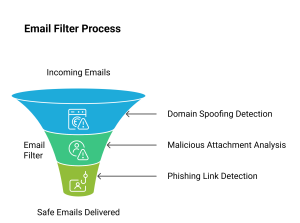 Email filters compare sender domains against trusted sources and flag discrepancies like a misspelled finances@yourcompnay.com to prevent impersonation. Email filters analyse malicious attachments, such as infected PDFs or Excel files in sandbox environments and blocks any attempt to execute harmful code. Additionally, phishing link detection mechanisms in email filters scan embedded URLs and match them against blacklist of known malicious sites to prevent users from being redirected to credential-stealing or ransomware-deploying websites.
How Data Loss Prevention (DLP) tool Helps
While email filters prevent phishing emails from entering the system, Data Loss Prevention (DLP) tools go one step further by preventing sensitive data from leaving your organisation if an employee unknowingly engages with a phishing email. Here’s how DLP works to mitigate the damage after an attack: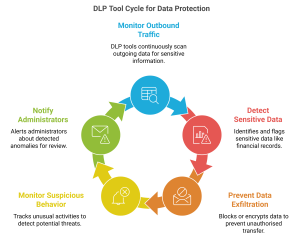
Data Loss Prevention (DLP) tools play a crucial role in limiting the damage caused by phishing attacks by monitoring and controlling outbound data transfers. If an attacker gains access to an employee’s system, DLP tools can detect attempts to send sensitive information like bank details, personally identifiable information (PII), or financial records going outside the organisation, and will block, encrypt, or flag the communication for review. Additionally, DLP systems track suspicious behaviours such as a sudden spike in email activity or attempts to send files to personal email accounts, helping to detect anomalies and prevent unauthorised data exfiltration.
Other Key Measures to Strengthen Defence
- User Awareness Training: Conduct monthly training sessions covering how to identify fake sender addresses, suspicious links, and urgent or unusual language. Use simulated phishing emails to assess employees and track who clicks. Provide follow-up training for high-risk staff. Encourage immediate reporting of suspicious emails to the IT/security team.
- Multi-Factor Authentication (MFA): MFA acts as a secondary layer of defence in case phishing succeeds. Even if an attacker gets hold of a password, they will not be able to access critical systems without the second factor.
- Regular Security Updates and Patch Management: Cybercriminals often exploit known vulnerabilities in software. By ensuring that all software is up to date with the latest security patches, businesses reduce the opportunity for attackers to compromise systems through phishing.
Final Thoughts
Phishing attacks do not slow down; they evolve. As EOFY approaches, hackers will likely ramp up their efforts to exploit the chaos in inboxes.
If navigating the complexities of cybersecurity and email protection seems daunting, we are here to help. Our team of experts specialises in fortifying your defences against phishing and other cyber threats.
Reach out for a consultation and let us tailor a solution that fits your business needs. Together, we can ensure that your End of Financial Year is secure without the fear of cyberattacks.